




Pot-Limit Omaha can be one of the most exciting and profitable forms of poker, but it is also one of the easiest games in which to experience a major downswing. Even strong players can lose dozens of buy-ins while continuing to make fundamentally correct decisions.
That is why proper PLO bankroll management is essential.
Your bankroll must be large enough to survive the natural variance of the game without forcing you to quit, chase your losses, or play with money needed for everyday expenses. The goal is not simply to avoid going broke. A well-managed bankroll also gives you the confidence to make better decisions without being distracted by the financial value of every pot.
This guide covers low- and mid-stakes PLO from $0.50/$1 through $3/$6. It explains how many buy-ins you should have, when to take a controlled shot at the next stake, when to move back down, and how to build a bankroll capable of supporting a long-term poker career.
What Are Low- and Mid-Stakes PLO?
There is no official definition of low-, mid-, or high-stakes Pot-Limit Omaha. However, online cash games are generally divided into broad categories based on the blinds, standard buy-in, quality of competition, and amount of money required to play comfortably.
PLO Cash Game Stake Levels
| Stake Level | Blind Structure | Standard 100 BB Buy-In | Typical Player Pool |
|---|---|---|---|
| Micro Stakes | $0.01/$0.02 to $0.25/$0.50 | $2 to $50 | Beginners, recreational players and new bankroll builders |
| Low Stakes | $0.50/$1 to $1/$2 | $100 to $200 | Winning recreational players and aspiring professionals |
| Mid Stakes | $2/$4 to $3/$6 | $400 to $600 | Experienced regulars, specialists and professional players |
| High Stakes | $5/$10 and above | $1,000+ | Established professionals and elite high-stakes regulars |
Many aspiring professionals begin at $0.50/$1 or $1/$2. These games provide an opportunity to develop technical skills, improve game selection, build confidence, and accumulate the bankroll needed to compete at $2/$4 and $3/$6.A player does not need to wait until reaching mid stakes to take poker seriously. The professional approach begins with how you study, manage your money, select games, track results, and respond to downswings.
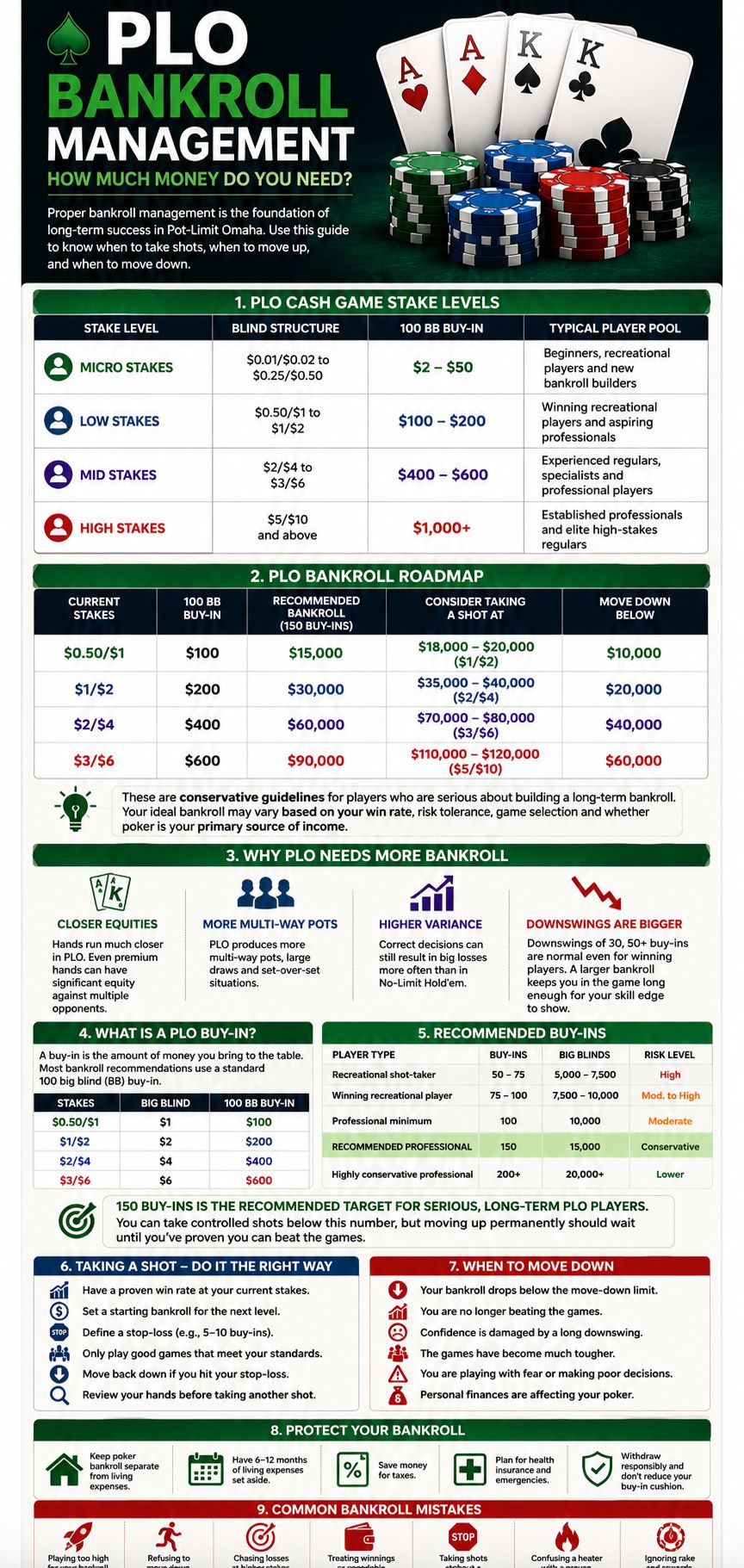
PLO Bankroll Roadmap
Low- and Mid-Stakes PLO Bankroll Chart
| Stake Level | Blind Structure | Standard 100 BB Buy-In | Typical Player Pool |
|---|---|---|---|
| Micro Stakes | $0.01/$0.02 to $0.25/$0.50 | $2 to $50 | Beginners, recreational players and new bankroll builders |
| Low Stakes | $0.50/$1 to $1/$2 | $100 to $200 | Winning recreational players and aspiring professionals |
| Mid Stakes | $2/$4 to $3/$6 | $400 to $600 | Experienced regulars, specialists and professional players |
| High Stakes | $5/$10 and above | $1,000+ | Established professionals and elite high-stakes regulars |
These are conservative guidelines intended for players treating poker as a serious source of income. Your exact requirements may vary depending on your win rate, playing style, average table size, game quality, risk tolerance, and ability to move down when necessary.
A recreational player with reliable outside income may be comfortable using a more aggressive approach. A full-time professional who regularly withdraws money for living expenses should normally use a more conservative one.
Pot Limit Omaha PLO Bankroll Management Infographic
Why PLO Requires a Larger Bankroll
Pot-Limit Omaha generally requires a larger bankroll than No-Limit Hold’em because equities run much closer.
In Hold’em, a premium hand can have a substantial preflop advantage. In PLO, even a strong double-suited aces hand may face an opponent with enough connectivity and suit coverage to have considerable equity.
PLO also produces more:
- Multi-way pots
- Large draws
- Combination draws
- Set-over-set situations
- Nut-versus-second-nut confrontations
- Preflop and post-flop all-ins
- High-equity hands that fail to hold
You can make the correct decision, get your money into the pot as a favourite, and still lose repeatedly. A winning player can experience a long breakeven stretch or lose 30, 50, or more buy-ins without necessarily playing badly.
The size of a possible downswing also depends on your win rate. A player with a small edge is more vulnerable to prolonged downswings than someone crushing the same games. As the competition becomes tougher, your expected win rate may decrease even while your technical ability improves.
This is why bankroll management cannot eliminate variance. Its purpose is to give you enough financial protection to survive it.
What Is a PLO Buy-In?
A buy-in is the amount of money you bring to the table.
Most online PLO bankroll recommendations assume a standard buy-in of 100 big blinds. At $1/$2, one full buy-in is $200. At $2/$4, it is $400.
Standard PLO Buy-In Sizes
| PLO Stakes | Big Blind | 100 BB Buy-In |
|---|---|---|
| $0.50/$1 | $1 | $100 |
| $1/$2 | $2 | $200 |
| $2/$4 | $4 | $400 |
| $3/$6 | $6 | $600 |
Thinking in buy-ins makes it easier to compare bankroll requirements across different stakes.
For example, a $30,000 bankroll may sound substantial. At $0.50/$1, it represents 300 buy-ins. At $1/$2, it represents 150 buy-ins. At $3/$6, it represents only 50 buy-ins.
The amount of money has not changed, but the protection provided by that bankroll has changed dramatically.

Play PLO online featuring the softest games.
How Many Buy-Ins Do You Need for PLO?
There is no single number that suits every player.
An aggressive recreational player may accept the risk of playing with 50 to 75 buy-ins, particularly when outside income is available. A professional who depends on poker winnings should keep considerably more.
Recommended PLO Buy-Ins
| Player Type | Suggested Buy-Ins | Equivalent Big Blinds | Risk Level |
|---|---|---|---|
| Recreational shot-taker | 50 to 75 | 5,000 to 7,500 BB | High |
| Winning recreational player | 75 to 100 | 7,500 to 10,000 BB | Moderate to high |
| Professional minimum | 100 | 10,000 BB | Moderate |
| Recommended full-time professional | 150 | 15,000 BB | Conservative |
| Highly conservative professional | 200+ | 20,000+ BB | Lower |
For a player attempting to build a professional poker career, 150 buy-ins is a sensible target.
This does not mean you must wait until you possess 150 buy-ins for the next level before playing a single hand there. Controlled shot-taking allows winning players to test tougher games before making a permanent move.
The difference is important:
- Taking a shot means temporarily testing the next stake with a predetermined loss limit.
- Moving up permanently means making the higher stake your primary game.
A player may take a shot with 90 to 120 buy-ins for the next level while continuing to play most sessions at the established stake. A complete transition should generally require more evidence that the player can beat the tougher games.
Bankroll Strategy for $0.50/$1 PLO
For many aspiring online professionals, $0.50/$1 is a practical place to begin.
The standard buy-in is $100, making a 150-buy-in bankroll equal to $15,000. That may appear conservative, but it provides room to handle normal PLO variance while building a meaningful sample of results.
At this level, the goal should not only be to win money. It should also be to build the habits needed at higher stakes.
Focus on:
- Selecting profitable tables
- Identifying weak players
- Avoiding marginal situations out of position
- Understanding nut potential
- Reviewing large pots
- Tracking your win rate
- Controlling tilt
- Playing a consistent volume
Once your bankroll reaches approximately $18,000 to $20,000, you may consider taking controlled shots at $1/$2, provided you have established a reliable win rate at $0.50/$1.
Do not immediately abandon your regular games. Continue playing most of your volume at $0.50/$1 while selectively entering attractive $1/$2 games.
Set a clear shot limit before beginning. For example, you might dedicate five buy-ins to the attempt. If you lose those five buy-ins, return to $0.50/$1 and rebuild.
If your total bankroll drops below approximately $10,000, moving down is the disciplined choice. Your bankroll would then contain fewer than 100 buy-ins for $0.50/$1.
Bankroll Strategy for $1/$2 PLO
The $1/$2 level is an important stage in the development of a serious PLO player.
A standard buy-in is $200, making the recommended 150-buy-in bankroll $30,000. The monetary swings become more noticeable, and the average regular is likely to be more experienced than at $0.50/$1.
Game selection becomes increasingly important. Your hourly profit does not depend only on how well you play. It also depends on who is sitting at the table, the seat you receive, the number of weak players in the game, and whether the rake structure allows your edge to translate into profit.
A winning $1/$2 player should avoid moving up solely because of one strong month. A meaningful sample should show that you can beat the games after accounting for rake, bonuses, and rewards.
Once your bankroll reaches approximately $35,000 to $40,000, you may begin taking controlled shots at $2/$4.
That range represents roughly 87 to 100 buy-ins for the new level. It can be enough for carefully selected shots, but it is not necessarily enough to play $2/$4 exclusively.
Continue using $1/$2 as your primary game while choosing favourable $2/$4 opportunities. If you lose your predetermined shot allowance, move back down without trying to immediately recover the loss at the higher stake.
If your bankroll falls below $20,000, return to lower limits and rebuild.
Bankroll Strategy for $2/$4 PLO
At $2/$4, a standard 100 big blind buy-in is $400. A 150-buy-in bankroll therefore equals $60,000.
This is the point where online poker may begin producing a substantial income for a proven winning player, but the financial swings can also become severe. A 20-buy-in downswing represents $8,000. A 50-buy-in downswing represents $20,000.
The games will often contain experienced regulars who study seriously, use available analysis tools, understand population tendencies, and compete aggressively for weaker players.
At this level, success depends on more than learning basic PLO strategy. You must also understand:
- Player-pool tendencies
- Positional ranges
- Three-bet and four-bet pots
- Stack-to-pot ratios
- Blocker effects
- Multi-way adjustments
- Rake and rewards
- Table and seat selection
A bankroll of approximately $70,000 to $80,000 may be sufficient for a proven $2/$4 winner to begin taking carefully selected shots at $3/$6.
This range provides roughly 117 to 133 buy-ins for $3/$6. It offers more protection than the earlier shot-taking thresholds because the financial consequences are becoming increasingly serious.
If your bankroll drops below $40,000, you would have fewer than 100 buy-ins for $2/$4. Moving back to $1/$2 protects your remaining capital and gives you a chance to rebuild in less volatile financial conditions.
Bankroll Strategy for $3/$6 PLO
At $3/$6, a full 100 big blind buy-in is $600. A recommended 150-buy-in bankroll equals $90,000.
These games may contain a mixture of strong professionals, experienced regulars, specialists, and occasional recreational players. The value of strong game selection becomes enormous.
You do not have to play every available table simply because your bankroll technically permits it. A disciplined professional should be willing to sit out poor games and wait for better opportunities.
At $3/$6:
- A 10-buy-in downswing is $6,000.
- A 25-buy-in downswing is $15,000.
- A 50-buy-in downswing is $30,000.
Those figures demonstrate why a separate living-expense reserve is so important. Withdrawing money from the poker bankroll during a downswing can rapidly reduce the number of buy-ins protecting your career.
A winning player may consider taking initial $5/$10 shots with a bankroll of approximately $110,000 to $120,000. However, the quality and availability of those games should influence the decision as much as the bankroll itself.
If your bankroll falls below $60,000, moving back to $2/$4 is generally the responsible decision.
When Should You Take a Shot at Higher Stakes?
Taking shots is a normal part of building a professional poker career. The mistake is not taking a shot and failing. The mistake is taking an uncontrolled shot with no plan for what happens if you lose.
Before playing the next stake, establish:
- A starting bankroll: Decide the minimum amount required before attempting the shot.
- A stop-loss: Determine how many higher-stakes buy-ins you are prepared to lose.
- A game-selection standard: Only enter games that meet your normal profitability requirements.
- A move-down point: Return to your established stake immediately if the shot allowance is lost.
- A review process: Analyze your higher-stakes sessions before deciding whether to continue.
A reasonable shot may involve three to ten buy-ins, depending on your bankroll and risk tolerance. The exact number matters less than choosing it in advance and following the plan.
Do not increase the shot allowance because you are losing. Do not chase losses in a poor game. Do not convince yourself that one more session will fix everything.
A failed shot is not a failure as a poker player. It is information. Move back down, review the hands, rebuild your bankroll, and try again when the conditions are right.
When Should You Move Down?
Moving down in stakes is one of the most important professional poker skills.
Players often resist moving down because they associate it with failure. In reality, moving down is how professionals protect their business capital.
Consider moving down when:
- Your bankroll reaches the predetermined limit.
- Your confidence has been damaged by a prolonged downswing.
- You are no longer beating the current player pool.
- The available games have become significantly tougher.
- You are playing with fear or avoiding correct high-variance decisions.
- You have withdrawn too much money from the bankroll.
- Personal financial pressure is affecting your decisions.
Moving down should not be an emotional decision made in the middle of a session. Establish your thresholds before the downswing begins.
When the number is reached, follow the plan.
Your Bankroll Is Not the Same as Your Net Worth
A $60,000 poker bankroll does not necessarily mean you can afford to play $2/$4 professionally.
That money should be dedicated to poker. It should not also represent your rent, food, taxes, vehicle repairs, medical expenses, or emergency savings.
A professional should ideally maintain separate funds for:
- Poker bankroll
- Six to twelve months of living expenses
- Emergency expenses
- Taxes
- Retirement or long-term savings
- Health and insurance costs
The poker bankroll is business capital. Withdrawals reduce the number of buy-ins supporting your current stake.
Suppose you begin playing $2/$4 with $60,000. If you withdraw $10,000 for personal expenses, you no longer have 150 buy-ins. You have 125. If you then experience a $10,000 downswing, your bankroll falls to $40,000, or 100 buy-ins.
This is how a seemingly well-funded professional can quickly become under-rolled.
Should You Use a More Aggressive Bankroll Strategy?
A more aggressive bankroll strategy may be reasonable when:
- You have reliable outside income.
- Poker is not paying your living expenses.
- You are willing to move down immediately.
- You have a strong, proven win rate.
- You play only carefully selected games.
- You can replenish the bankroll from other income.
- The money is not needed for essential expenses.
A conservative strategy is usually better when:
- Poker is your primary income.
- You regularly withdraw money.
- You support a family.
- Your win rate is small or uncertain.
- You play high-variance formats or short-handed games.
- The player pool is difficult.
- Moving down would substantially reduce your income.
The correct bankroll is not only a mathematical question. It is also a personal and professional risk-management decision.
Common PLO Bankroll Management Mistakes
Playing Too High Because the Game Looks Soft
A good game does not remove variance. You still need enough bankroll to survive losing sessions.
Refusing to Move Down
Staying in a game after crossing your move-down threshold converts a manageable downswing into a possible bankroll disaster.
Chasing Losses at Higher Stakes
Moving up to recover losses faster is one of the quickest ways to destroy a bankroll.
Treating Winnings as Spendable Income
Every withdrawal reduces the number of buy-ins supporting your current game. Pay yourself deliberately rather than spending directly from the bankroll.
Taking Shots Without a Stop-Loss
A shot without a defined limit can become an unplanned permanent move into a game you cannot afford.
Confusing a Heater With a Proven Win Rate
A few profitable weeks do not prove that you can beat a stake. Use a meaningful sample and review the quality of your decisions.
Ignoring Rake and Rewards
Your actual win rate includes rake, bonuses, rakeback, leaderboards, and other rewards. A player who appears to beat the table may still have a weak overall return after costs.
Playing Too Many Tables Online
Increasing table volume can reduce decision quality and increase variance if you are unable to maintain your edge.
PLO Bankroll Management FAQs
Is 100 buy-ins enough for PLO?
One hundred buy-ins can be enough for a proven winning player who is willing to move down, but it should generally be considered the minimum for professional PLO. A bankroll of approximately 150 buy-ins provides stronger protection.
How much money do I need to play $0.50/$1 PLO?
A standard buy-in is $100. A 100-buy-in bankroll is $10,000, while the recommended 150-buy-in bankroll used in this guide is $15,000.
How much money do I need to play $1/$2 PLO?
A full buy-in is $200. One hundred buy-ins equals $20,000, while 150 buy-ins equals $30,000.
How much money do I need to play $2/$4 PLO professionally?
A standard buy-in is $400. The professional minimum of 100 buy-ins equals $40,000. A more conservative 150-buy-in bankroll equals $60,000.
How much money do I need to play $3/$6 PLO professionally?
A standard buy-in is $600. One hundred buy-ins equals $60,000, while 150 buy-ins equals $90,000.
Can you become a professional playing $0.50/$1 PLO?
You can begin building a professional poker career at $0.50/$1. However, whether the game can provide a sustainable full-time income depends on your win rate, volume, rewards, expenses, and local cost of living.
When should I take a shot at the next stake?
Consider taking a controlled shot when you have a proven win rate at your regular stake, enough buy-ins for the next level, a predetermined stop-loss, and access to a profitable game.
How many buy-ins should I risk during a shot?
Many players risk approximately three to ten buy-ins during a controlled shot. The exact number should be chosen before playing and should not be increased because you are losing.
Should I include living expenses in my poker bankroll?
No. Your poker bankroll and living expenses should be kept separate. A professional should ideally maintain several months of personal expenses outside the poker bankroll.
Is PLO more volatile than No-Limit Hold’em?
Generally, yes. PLO produces closer equities, more large draws, more multi-way pots, and more frequent high-equity all-ins, all of which can increase variance.
Final Thoughts
Successful PLO bankroll management is not about choosing the largest game you can technically afford. It is about staying in action long enough for your skill advantage to produce results.
For a serious low- or mid-stakes player, 100 buy-ins should normally be considered the professional minimum. A bankroll of approximately 150 buy-ins provides a more practical level of protection for someone attempting to build a long-term poker career.
That means approximately:
- $15,000 for $0.50/$1
- $30,000 for $1/$2
- $60,000 for $2/$4
- $90,000 for $3/$6
You do not need to wait until you have a complete 150-buy-in bankroll for the next level before taking a carefully controlled shot. However, you should have a proven win rate, a fixed loss limit, and the discipline to return to your regular stake if the attempt fails.
The best professional players do not avoid moving down because of pride. They protect their bankroll, select profitable games, control their expenses, and understand that surviving variance is part of the job.
In Pot-Limit Omaha, skill may determine your long-term results—but bankroll management determines whether you remain in the game long enough to realize them.
Cheers and may the poker gods be with you!
%20Bankroll%20Management%20Guide:%20$0.50/$1%20to%20$3/$6)