




f you’ve ever sat down at an Omaha Hi-Lo table expecting it to play like Pot-Limit Omaha, you’re in for a rude awakening. Omaha Hi-Lo—also known as Omaha Eight-or-Better or simply Omaha 8—is a split-pot game where the best high hand and the best qualifying low hand divide the pot. That changes everything about starting hand selection.
Unlike the best PLO starting hands, huge pairs like AAKK aren’t always monsters if they can’t make the nut low. The strongest Omaha Hi-Lo hands have the potential to scoop both halves of the pot, giving you multiple ways to win on every street.
This guide ranks the 20 best Omaha Hi-Lo starting hands, explains why they’re profitable, and includes an easy cheat sheet you can keep beside your monitor during online sessions.
Why Starting Hands Matter in Omaha Hi-Lo
Because every player receives four hole cards, the number of possible hand combinations is enormous. Many beginners overvalue high-only hands, but experienced Omaha Eight-or-Better players know that the biggest profits come from scooping.
The ideal starting hand can:
- Make the nut flush
- Make the nut straight
- Make the nut low
- Have counterfeit protection
- Win both halves of the pot
Whenever possible, you’re looking for hands that can earn the entire pot rather than chopping it with several opponents.
Top 20 Omaha Hi-Lo Starting Hands Chart
| Rank | Starting Hand | Suitedness | High Potential | Low Potential | Overall Rating |
|---|---|---|---|---|---|
| 1 | A♠ A♦ 2♠ 3♦ | Double-suited | Excellent | Excellent | Elite |
| 2 | A♠ A♦ 2♠ 4♦ | Double-suited | Excellent | Excellent | Elite |
| 3 | A♠ A♦ 2♠ 5♦ | Double-suited | Excellent | Excellent | Elite |
| 4 | A♠ 2♠ 3♦ 4♦ | Double-suited | Excellent | Excellent | Elite |
| 5 | A♠ A♦ 3♠ 4♦ | Double-suited | Excellent | Excellent | Elite |
| 6 | A♠ 2♠ 3♦ 5♦ | Double-suited | Excellent | Excellent | Premium |
| 7 | A♠ 2♠ 4♦ 5♦ | Double-suited | Excellent | Excellent | Premium |
| 8 | A♠ A♦ 2♠ K♦ | Double-suited | Excellent | Very good | Premium |
| 9 | A♠ 2♠ K♦ K♣ | Single-suited | Excellent | Very good | Premium |
| 10 | A♠ A♦ 2♠ Q♦ | Double-suited | Excellent | Very good | Premium |
| 11 | A♠ 2♠ J♦ Q♦ | Double-suited | Very good | Excellent | Excellent |
| 12 | A♠ 2♠ 6♦ 7♦ | Double-suited | Very good | Excellent | Excellent |
| 13 | A♠ 3♠ 4♦ 5♦ | Double-suited | Very good | Excellent | Excellent |
| 14 | A♠ A♦ 3♠ 5♦ | Double-suited | Excellent | Very good | Excellent |
| 15 | A♠ 2♠ 7♦ 8♦ | Double-suited | Very good | Very good | Strong |
| 16 | A♠ 2♠ 9♦ 10♦ | Double-suited | Very good | Very good | Strong |
| 17 | A♠ 2♠ Q♦ K♦ | Double-suited | Excellent | Good | Strong |
| 18 | A♠ 3♠ Q♦ K♦ | Double-suited | Very good | Good | Strong |
| 19 | A♠ 2♠ 5♦ 6♦ | Double-suited | Very good | Excellent | Strong |
| 20 | A♠ 3♠ 6♦ 7♦ | Double-suited | Very good | Very good | Strong |
Note: Omaha Hi-Lo is also known as Omaha Eight-or-Better, Omaha 8, or O8. Rankings assume strong suited configurations where shown. Exact hand strength changes according to position, table size, betting structure, and the number of players in the pot.
Best Omaha Hi-Lo Starting Hands Infographic
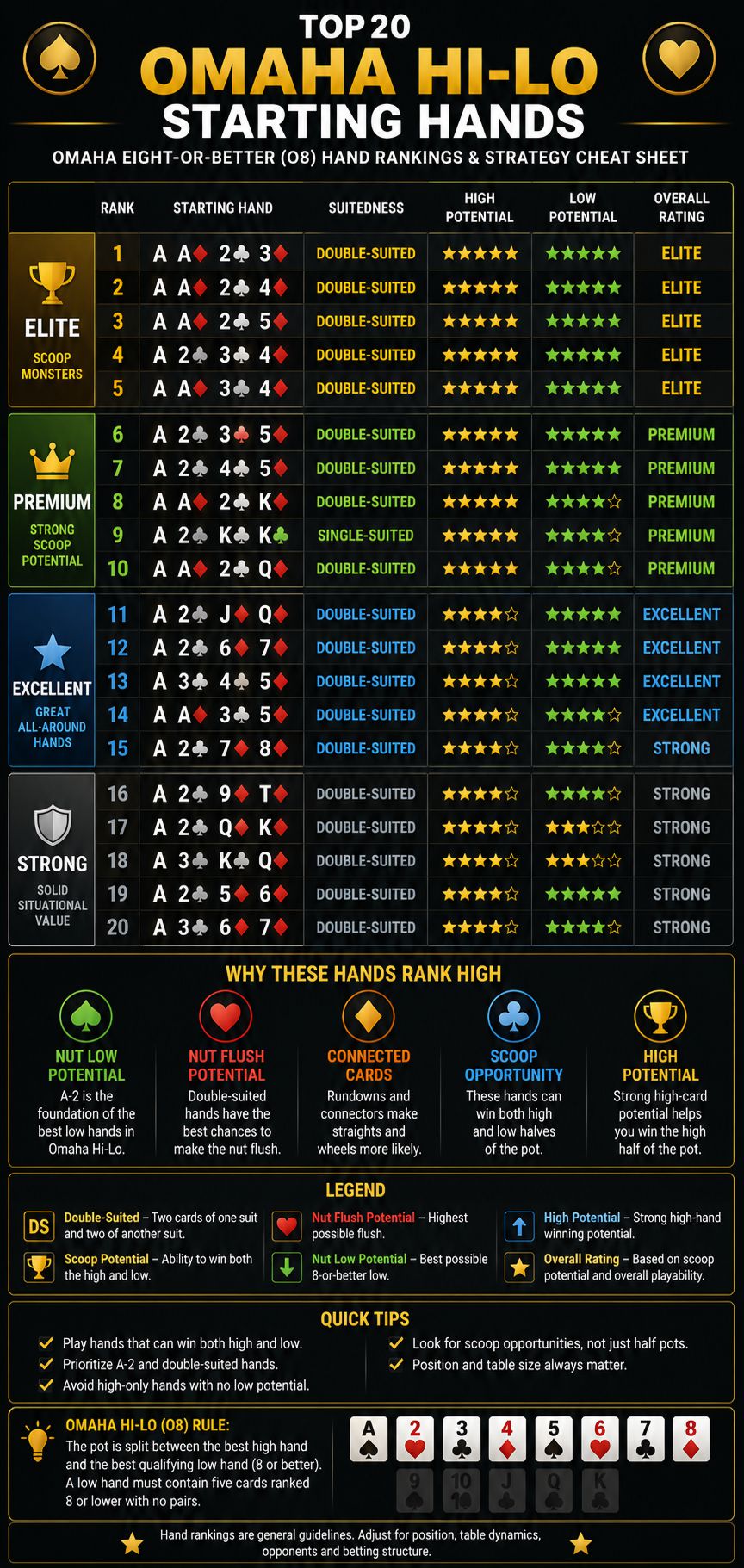
Why These Hands Rank So Highly
1. A-2 is King
If there’s one rule every Omaha Eight-or-Better player should remember, it’s this: A-2 is the foundation of winning low hands. Without A-2, you’re often chasing the second-best low, which can become an expensive habit.
2. Double-Suited is a Huge Advantage
Double-suited hands dramatically increase your chances of making the nut flush. In split-pot games, that extra equity often means the difference between winning half the pot and scooping the entire thing.
3. Connected Cards Add Scoop Potential
Hands like A-2-3-4 can make:
- Nut straights
- Nut lows
- Wheel straights
- Backdoor flushes
That’s exactly the kind of versatility you want.
4. Counterfeit Protection Matters
Hands with A-2-3-X remain strong even when the board pairs your low cards. Having multiple low combinations gives you protection against being counterfeited and keeps you drawing to the nut low more often.
5. High Cards Still Matter
While low hands are essential, don’t ignore the high half of the pot. A hand like A-A-2-K combines premium high-card strength with the ability to make the nut low, making it a consistent winner.
Starting Hands to Avoid
Many beginners lose money with attractive-looking hands that have little scoop potential.
Avoid hands like:
- K-K-Q-J
- Q-Q-J-T
- J-T-9-8
- A-K-Q-J (without low cards)
- Four middle cards with no Ace
These hands can win the high half but often have no chance of qualifying for the low.
Beginner Tips
- Play hands with A-2 aggressively.
- Chase the nut low, not second-best lows.
- Prefer double-suited hands whenever possible.
- Look for scoop opportunities instead of chopping.
- Avoid high-only starting hands in full-ring games.
Frequently Asked Questions
What is the best starting hand in Omaha Hi-Lo?
Most professionals consider A-A-2-3 double-suited the strongest starting hand because it has exceptional potential to win both the high and low halves of the pot.
Is Omaha Hi-Lo the same as Omaha Eight-or-Better?
Yes. The names Omaha Hi-Lo, Omaha Eight-or-Better, and Omaha 8 all refer to the same split-pot poker variant where a qualifying low hand must be eight-high or lower.
Is A-2 always a good starting hand?
A-2 is the most valuable low-card combination, but it performs best when paired with suited cards, connectivity, or premium high-card strength.
Why are double-suited hands better?
Double-suited hands have more opportunities to make the nut flush, increasing their equity and scoop potential.
Should beginners play every hand with A-2?
No. A-2 should ideally be accompanied by strong supporting cards. Weak kickers and poor connectivity can leave you with only half the pot or a dominated low draw.
Final Thoughts
Winning at Omaha Hi-Lo (Omaha Eight-or-Better) starts long before the flop. By choosing starting hands that can compete for both the high and low halves of the pot, you’ll put yourself in far more profitable situations than players chasing one-way holdings.
If you’re serious about improving your results, memorize these Top 20 Omaha Hi-Lo Starting Hands, stick to hands with genuine scoop potential, and don’t be afraid to fold attractive-looking high-only hands that are unlikely to earn the whole pot.
Cheers and may the poker gods be with you!
)